Y. Nagaraju (Kannada: ವೈ. ನಾಗರಾಜು; 27 August 1905 – 2 August 1979) was an Indian painter who served as an artist of the Mysore Palace for over three decades, from 1922 to 1957.[1, p. 5][13] He worked mainly in oils, painting portraits of the Mysore royal family, religious subjects and scenes of the Mysore Dasara. He was one of the painters of the Dasara procession series in the Kalyana Mantapa of the Mysore Palace.[5][6][15][7][14, pp. 693, 698] The historian Janaki Nair names him among the palace artists who came from traditional artisan families, and as one who visited Europe before returning to palace service.[2, pp. 3, 12]
Family and early life
Nagaraju belonged to the Somavamsha Arya Kshatriya community and to a lineage of painters that, according to his biographer, had served at Vijayanagara and scattered after its decline. The family settled at Turuvekere in Tumkur district, and Diwan Purnaiah later brought its elders to Mysore, where several of them served the palace.[1, p. 3]
His grandfather Sundaraiah was an artist at the courts of Krishnaraja Wadiyar III and Chamaraja Wadiyar X. His father, Yellappa, began as a designer during the rebuilding of the Mysore Palace after the fire and became a palace draughtsman. His mother was Krishnamma.[1, p. 3] Nagaraju was born on 27 August 1905; his younger brother, the painter Y. Subramanya Raju, was born on 3 December 1907.[1, p. 3]
Education
After schooling at the Raja School, Mysore, Nagaraju studied at the Chamarajendra Technical Institute from 1915, under a faculty led by the principal Herald G. Alderton, with K. Keshavaiah and R. V. Naidu teaching portraiture.[1, p. 4][13] He passed the Government of Madras examinations in drawing, painting and design, and continued advanced work at the institute until 1922. Work he made as a student was shown at the British Empire Exhibition of 1924. On his leaving, Alderton certified that “He is a hereditary artist of considerable abilities.”[1, p. 4]
While he was still a student, the Yuvaraja, Kanteerava Narasimharaja Wadiyar, saw and praised his work during a visit to the institute.[1, p. 5][13]
Palace artist, 1922–1957
Mirza Ismail, later Diwan of Mysore, showed Nagaraju’s work to Maharaja Krishnaraja Wadiyar IV, who selected several pieces for the palace, awarded a cash prize and, within days, appointed him palace artist on 1 December 1922.[1, p. 5] He kept a studio in the northern part of the palace and painted members of the royal family from life, sometimes under the Maharaja’s direct supervision.[1, pp. 5–6] He was paid by commission — about Rs. 100 for a royal portrait and up to Rs. 1,000 for the large Dasara canvases — in addition to an honorarium of Rs. 50 a month, which ended with his retirement from the palace in 1957.[1, p. 8] His palace service lasted 34 years and five months, to 30 April 1957.[13][12]
European study tour, 1927
While Nagaraju was painting the Yuvaraja’s portrait at the Chamundi palace, the Yuvaraja suggested that he see the exhibitions and museums of France and England. With the Maharaja’s approval he was sent in 1927 “not as an artist but as a student of art”, on a monthly scholarship of Rs. 250.[1, pp. 6, 8][13] His biographer considers him perhaps the first artist from the old Mysore region to travel abroad.[1, p. 6]
He sailed with the Yuvaraja from Bombay on the Rajputana, by way of Aden, Suez and Marseilles. In Paris he visited the Salon, the Louvre, the Musée du Luxembourg, Versailles and the Panthéon; in London, the Royal Academy exhibition, the National Gallery, the Victoria and Albert Museum, the Wallace Collection, the Tate, the National Portrait Gallery, the British Museum and the Royal College of Art.[1, pp. 6–7][13]
He asked William Rothenstein, principal of the Royal College of Art, for admission, and was accepted after an entrance test of life drawing. A cable from Mysore conveyed that “if Nagaraju wishes and if the Prince feels it necessary, Nagaraju may study art in London, as the King has no objection.” The college was by then closed for the summer, his passage home was booked, and Krishnaraja Wadiyar IV’s Silver Jubilee was approaching, so he returned to Mysore.[1, p. 7]
Principal works
The Last Four Rulers of Mysore (1926)
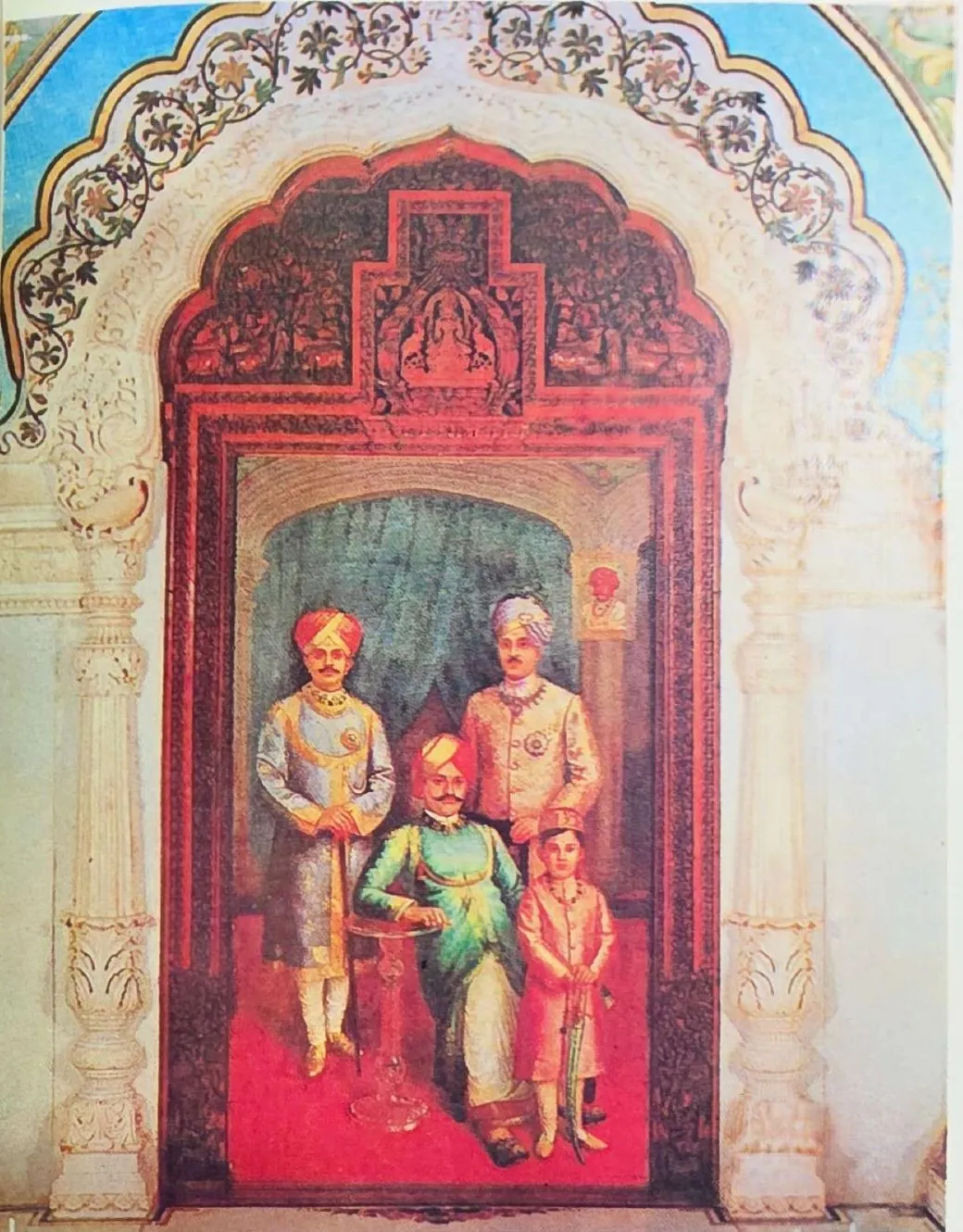
Painted in 1926 at the behest of Krishnaraja Wadiyar IV, this composition shows Krishnaraja Wadiyar IV, the Yuvaraja Kanteerava Narasimharaja Wadiyar and the young Jayachamarajendra Wadiyar, with Krishnaraja Wadiyar III in the background; it was exhibited in the Durbar Hall as “a portrait of four generations”. His biographer notes that the figures belonged to different periods, a device Europeans called “anachronism”.[1, pp. 10–11] The family’s notes, which use the title The Last Four Rulers of Mysore, also include Chamaraja Wadiyar X, give the size as 10 × 7 ft, and record that the Maharaja himself described the work as an anachronism (kalaviparyaya), since Jayachamarajendra had not been born in Chamaraja Wadiyar X’s lifetime.[13]
Sri Chamundeshwari
As the idol at Chamundi Hill could not be photographed, Nagaraju was allowed to study it closely for some time before painting it. His painting shows the goddess seated, one foot on a stool, with eight weapons in her eight hands, in the sky above Chamundi Hill, with the path, the temple and the palace on the hill lit at dusk.[1, p. 11][13]
The Dasara procession series
The series of oil paintings recording the Mysore Dasara procession was begun in 1933 by K. Keshavaiah, Y. Nagaraju, Y. Subramanya Raju and S. Shankar Raju, later joined by S. Nanjundaswamy, S. Narasimhaswamy and S. R. Iyengar, and took ten years to complete. Nagaraju painted two of the large panels — the First Battalion of the Mysore Infantry, and Krishnaraja Wadiyar IV, Narasimharaja and Jayachamaraja on horseback — three smaller panels, and the Chamundeshwari car festival.[1, pp. 11–12] According to the Mysore Palace Board’s visitors’ guide, the paintings depict the processions of 1934–1945 and are based on photographs; they are displayed in the Kalyana Mantapa of the palace.[6][5][15][7][14, pp. 693, 698]
Portraits
His biographer counts more than a hundred portraits, chest-length and full-length, painted from sitters.[1, p. 18] Besides the royal family, his sitters included Mirza Ismail and Sir M. Visvesvaraya, whose portrait, signed by the sitter, is at the B.M.S. Technical College, Bangalore. He painted a 12-foot portrait of Gandhi for the Dasara exhibition, a 15 × 15 ft composition of Bharat Mata for the stage of the Rangacharlu Town Hall, Mysore, and “the Maharaja reclining on the golden throne” (1933).[1, pp. 10–12] A 1942 painting of the young Jayachamarajendra Wadiyar receiving his mother’s blessing is in the collection of Ramsons Kala Pratishtana, Mysore, as is a portrait connected with the 1927 Silver Jubilee of Krishnaraja Wadiyar IV; portraits of Jayachamarajendra Wadiyar by him are displayed in the Jaganmohan Palace gallery.[8][9]
See the list of works for locations.
Later life
After leaving the palace in 1957 Nagaraju worked from his own studio in Mysore, painting portraits and colouring enlarged photographs in oils.[1, p. 14][13] In July 1960 he was one of the 47 founder members who registered the Mysore Pradesh Chitrakala Parishath, now the Karnataka Chitrakala Parishath.[4] On 7 October 1961 he gave the inaugural address of the Fine Arts Club of D. Banumaiah’s College of Commerce, Mysore.[11] Unlike many of his contemporaries he did not teach at the Chamarajendra school and had no disciples; asked how many students he had trained, he would point to the technical school nearby. He did teach for a short time at the Chitrakala Parishath.[1, p. 19]
On 13 December 1978 he was recorded in conversation with M. Ramanarasaiah at Akashvani, Mysore; the recording was later re-broadcast from the station’s archive.[10] He was still working at the end: on 2 August 1979 he had brought colours to the studio for a new painting, but collapsed at home and died the same day.[1, p. 8] He was married first to Gowramma of Bangalore and, after her death, to Kamalamma; each marriage produced two sons and three daughters.[1, p. 9]
Honours
- Silver plate for an exhibit at the Dasara Exhibition, as a schoolboy; prize in the competition for the Durbar Hall designs; a cup for a palace pencil sketch.[1, pp. 7–8]
- Citation at the Chitrakala Parishath assembly, 22 August 1965.[1, p. 7][13]
- Honorary award of the Karnataka (then Mysore State) Lalitha Kala Academy, 1972.[3][1, p. 7]
- Title Chitrakala Praveena, conferred at the conference of the Somavamsha Arya Kshatriya community, Bangalore, January 1973.[1, p. 7][13]
Assessment
Nagaraju belonged to the generation that carried the hereditary painters of the Mysore court from the traditional style into academic realism and oil portraiture. His biographer places him at that point of change — between Ravi Varma’s last paintings for Mysore, delivered in the year of his birth, and the arrival of modernism — and argues that this period “had escaped the attention of the historians of art in Karnataka”.[1, pp. 1–2, 15] Janaki Nair, writing about K. Venkatappa, uses Nagaraju as an example of a palace artist who, after “testing the waters of the modern art world, even visiting Europe, returned to the comforting security of the Palace.”[2, p. 12]
A note on dates and figures
- Age at appointment. The biography says he was “just eighteen” when appointed palace artist on 1 December 1922. By his recorded date of birth, 27 August 1905, he was 17 years and 3 months old. This site therefore gives the date, not an age.[1, pp. 3, 5]
- The family notes give 1917 for the Yuvaraja’s visit to the institute and 27 January 1973 for the Chitrakala Praveena title; the biography gives 1916 and 20 January 1973.[13][1, pp. 5, 7]
- The family notes give 1920 and 1921 for his two Madras examinations; the biography gives 1921 for the diploma.[13][1, p. 4]
- The biography counts 28 Dasara paintings by all the artists, plus a 29th (the Chamundeshwari car festival, by Nagaraju); The Hindu gives 26 paintings in the Kalyana Mantapa.[1, pp. 11–12][5]
- The biography places the Yuvaraja’s suggestion of the European tour at the “Chamundi Palace”; the family notes call it Chamundi Vihar Palace.[1, p. 6][13]